Is Autoblogging.ai Good for Keyword Research? An Honest Review
You need keywords that rank, but you are already paying for an AI writer. That overlap matters if the tool you use to generate articles cannot also find the terms worth targeting. Most writers separate keyword research from drafting, which doubles the work and the cost.
This review explains what Autoblogging.ai actually does for keyword research, from SERP competitor analysis and LSI keywords in Godlike Mode to Knowledge Graph extraction. You will see how research feeds the workflow, what the pricing plans include, and who should rely on it for keyword discovery.
What Is Autoblogging.ai?
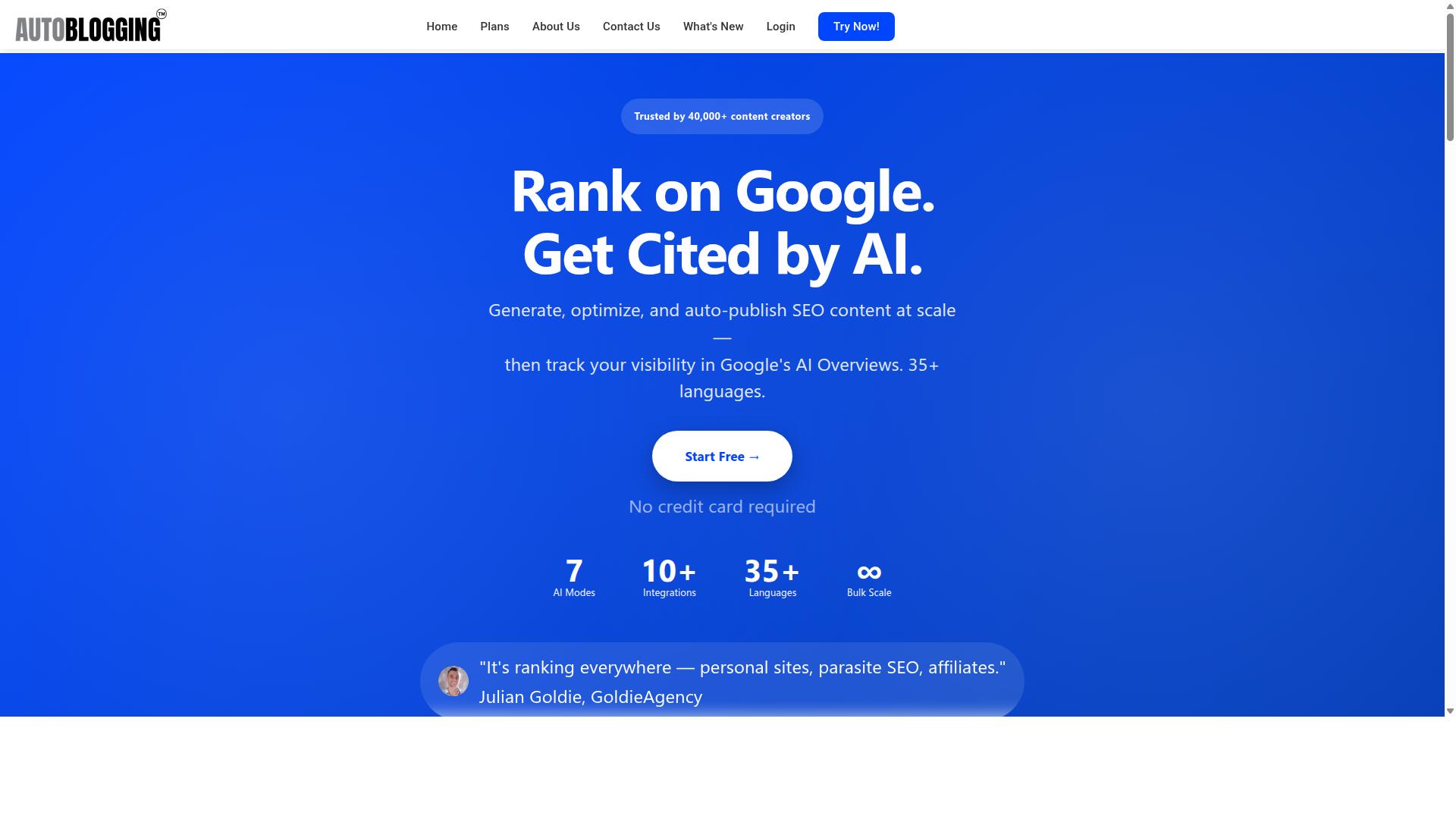
Autoblogging.ai is an AI-powered content generation platform that automates article creation for bloggers, agencies, and SEO professionals. It is a SaaS product, meaning users access it online rather than installing software on their own machines, and it is built by Digimetriq.com.
The core purpose is straightforward: save time and improve online presence. Producing content at scale is one of the biggest bottlenecks in any SEO workflow, and this platform is designed to remove that bottleneck by handling the first draft for you.
Because the tool sits in the content production layer, it matters to anyone researching keywords. A keyword list is only useful if you can act on it, and the ability to turn a researched topic into a working draft is what closes that gap. That is the role Autoblogging.ai plays in a broader SEO tool stack.
Its stated mission is to cut down content costs and give the power to human counterparts within their standard operating procedures by delivering the first draft. Digimetriq, the company behind it, has a longer-term aim of replacing human counterparts entirely.
At a high level, the platform covers the essentials of automated blogging: generating articles from inputs, supporting bulk content creation, and fitting into the workflows that bloggers and agencies already use. The specifics of how each capability works are covered elsewhere, but the positioning is clear. This is a content automation platform, not a keyword research suite, and understanding that distinction is central to any honest review.
Who Built It and Who It Serves
Autoblogging.ai was founded in 2022 by Vaibhav Sharda, who has been automating processes since 2011. That decade-plus background matters, because it points to a founder who approached content generation as a process problem rather than a one-off writing task.
Sharda also founded Autolinking.ai, and Autoblogging.ai itself grew out of processes developed at Digimetriq before being launched as a standalone SaaS. The product is therefore a product of Digimetriq.com, shaped by internal workflows rather than built in isolation.
The audience the platform serves is broad but specific in its needs:
- Bloggers who publish regularly and need to keep pace with their own content calendar
- Website owners who want to grow organic traffic without hiring a full content team
- SEO professionals who need first drafts ready for editing and content optimization
- Marketing agencies managing content output across multiple client websites
- Affiliate marketers running niche sites that depend on steady publishing volume
Those use cases look different on the surface, but they share one thing: a constant demand for content that outpaces available time. A personal blog, an affiliate site, and a client website all need fresh pages to compete, and each one benefits when the blank page is no longer the starting point.
This is where the tool's value connects back to keyword research. Whether you are doing niche research for a new affiliate project or building topic clusters for a client, the research phase produces a plan. Autoblogging.ai serves the stage right after that plan, turning identified topics and search intent into drafts that a human can refine, which keeps the whole workflow moving instead of stalling at production.
Is Autoblogging.ai Good for Keyword Research? The Direct Answer
Yes, Autoblogging.ai is effective for keyword research, particularly because its Godlike Mode performs SERP competitor analysis and extracts LSI keywords. That makes it a genuinely useful option for anyone who wants keyword discovery to feed directly into content production.
The important caveat is this: Autoblogging.ai is not a standalone keyword research tool. It does not try to replace dedicated platforms built purely for search volume charts, keyword difficulty scores, or backlink profiling. Instead, it folds keyword research into a content generation workflow, so the terms you uncover move straight into articles rather than sitting in a spreadsheet.
For a full honest review, that distinction matters. If your goal is deep niche research with historical trend data, a specialist SEO tool will serve you better. If your goal is finding the keywords your competitors rank for and turning them into publishable content, Autoblogging.ai covers both steps in one place.
Here is where it fits best and where it does not:
- Strong fit: users who want keyword research as part of an automated blogging pipeline
- Strong fit: anyone building topic clusters and pillar pages who needs semantic terms, not just head terms
- Weaker fit: researchers who need standalone rank tracking or backlink profile analysis
- Weaker fit: teams that already own an enterprise SEO suite and only need writing help
The reason it holds up is the underlying method. Godlike Mode analyzes the pages already ranking for a query, then pulls out the related terms, entities, and LSI keywords those pages share. That is a practical form of semantic SEO, and it aligns with how modern search engines evaluate topical depth rather than exact-match repetition.
So the direct answer is a qualified yes. Autoblogging.ai is good for keyword research when you judge it as one stage of a larger content automation system, not as a replacement for every SEO tool on the market.
Keyword Research Features Inside Autoblogging.ai
Autoblogging.ai incorporates keyword research features directly into its article generation process, focusing on SERP analysis and semantic relevance. Rather than treating keyword research as a separate task, the platform builds it into the writing workflow itself.
This matters because keyword research and content creation are usually handled in two different tools. You find your terms in one place, then try to write around them somewhere else. Autoblogging.ai closes that gap by pulling research signals into the generation step.
The platform's keyword-focused capabilities live mainly inside Godlike Mode, along with related optimization tools such as Semantic SEO Analysis, Topical Maps, and Fan Out Queries. Together these features aim to make generated content more competitive by aligning it with search intent and semantic SEO principles.
For anyone running an automated blogging operation, this built-in approach reduces the friction between research and publishing. You still need to choose sensible target keywords, but the tool handles much of the supporting analysis that used to require manual effort.
SERP Competitor Analysis and LSI Keywords in Godlike Mode
In Godlike Mode, Autoblogging.ai performs SERP competitor analysis and extracts LSI keywords. This is the core of its SERP analysis capability.
LSI keywords are the related terms and phrases that consistently appear in content ranking for a topic. Search engines use these associations to judge whether a page genuinely covers a subject. By pulling them from top-ranking pages, the tool identifies the vocabulary your content needs to compete.
Consider the keyword "best running shoes." Competitor articles ranking for that term commonly discuss cushioning, arch support, and breathability. Godlike Mode would extract terms like these and weave them into the generated article.
The practical benefit is coverage. A writer working from memory might miss half of these subtopics. The tool surfaces them automatically, so the finished piece addresses what searchers actually expect to find.
This also helps with long-tail keywords and related queries. When you cover the surrounding vocabulary thoroughly, your article has more chances to appear for variations of the main term.
It is worth being clear about what this feature is not. Godlike Mode does not hand you a full keyword strategy with search volume and keyword difficulty scores for hundreds of terms. It focuses on the terms that matter for the specific article you are generating.
For that narrower job, the approach is sound. Analyzing what already ranks is one of the most reliable ways to understand search intent, and building that analysis into generation saves real time.
Knowledge Graph Extraction and Semantic SEO Signals
Autoblogging.ai extracts entities from Google's Knowledge Graph to enhance the semantic depth of generated content. Entities are the people, places, brands, and concepts connected to your topic.
For a keyword about a city, for example, entities might include landmarks, nearby regions, and well-known local figures. For a product topic, they could include the manufacturer, related technologies, and competing models.
Why does this matter for ranking? Search engines increasingly evaluate content by understanding entities and the relationships between them, not just matching keywords. Including the right entities signals that your article genuinely understands its subject.
This supports topical authority. When a site consistently publishes content that covers entities accurately and in context, it builds credibility with search engines over time.
Entity extraction also improves how your content fits into broader structures. It pairs naturally with the platform's Topical Maps and Fan Out Queries tools, which help organize content around related themes rather than isolated keywords.
This is the heart of the platform's semantic SEO strategy. Instead of stuffing a target phrase into a page repeatedly, the tool aims to produce content that reads as a knowledgeable discussion of the topic.
For readers, the result is more useful articles. For site owners, it means content that is better positioned to hold rankings as the Google algorithm continues to favor depth and relevance over surface-level keyword matching. The Semantic SEO Analysis tool, a 21-point audit, gives you a way to check that depth after publishing.
Judged on these features, Autoblogging.ai handles keyword research well for its intended purpose. It is not a standalone research suite for building a niche from scratch, but as a way to align generated content with search intent and semantic signals, it delivers what most automated blogging workflows need.
How Keyword Research Fits Into the Autoblogging.ai Workflow
Keyword research is integrated into the content generation workflow, from initial keyword input to final publishing. Instead of treating research and writing as two separate jobs, Autoblogging.ai connects them inside one SaaS platform so that the keyword you choose directly shapes the article you receive.
The process follows a clear sequence. A user enters a keyword, the system analyzes the search engine results page for that term, and it extracts LSI keywords and related entities from the competing content. Those signals then feed into the draft, which is written to match the topic and the search intent behind the query.
This matters because keyword research is only useful when it changes what gets written. Many AI content generators accept a topic and produce generic text, leaving the writer to handle optimization manually. Autoblogging.ai builds the research layer into generation itself, so the output already reflects the language and subtopics that rank.
The workflow is also built for scale. Because each step is automated, the same process that handles one keyword can handle hundreds, which is what makes bulk content creation practical for agencies, affiliate marketers, and site owners running automated blogging operations. The research does not sit in a separate spreadsheet. It moves with the keyword through every stage, from SERP analysis to a finished, publishable article.
From Keyword to First Draft: Quick Mode, Bulk Generation and One-Click WordPress Publish
Quick Mode allows users to generate a single article from a keyword for free, while Bulk Generation can produce up to 500 articles at once. These two entry points cover very different needs, and both keep keyword research at the center of the process.
Quick Mode is the simplest path. A user enters one keyword and receives a draft, which makes it a practical way to evaluate output quality before committing to a larger workflow. For anyone running an honest review of the tool's research capabilities, this is the fastest way to see how a keyword translates into structured content.
Bulk Generation scales that same logic. Users upload a list of keywords via CSV and generate multiple articles in a single run, up to 500 at a time. For long-tail keywords and niche research, where volume matters more than individual precision, this turns a keyword list into a content library without manual drafting between each piece.
Autoblogging.ai also offers Godlike Mode, which performs SERP competitor analysis, extracts LSI keywords, and pulls from a knowledge graph. That combination supports semantic SEO and entity extraction, helping articles align with how search engines interpret a topic rather than just matching a phrase.
Publishing closes the loop. The platform includes WordPress integration with unlimited sites, one-click publishing, a plugin, and scheduled auto-posting. It also supports Web 2.0 platforms such as Medium, Dev.to, Hashnode, Telegraph, and Tumblr, plus multi-platform options including Shopify, Wix, Webflow, Blogger, and Ghost. API access, Zapier, and n8n connections extend that reach further.
For readers asking whether Autoblogging.ai is good for keyword research, the workflow answers the question directly. Keywords drive SERP analysis, LSI extraction, and entity mapping, and the resulting articles move straight to publishing. It is a genuine SEO tool and AI content generator in one, and for teams that need research and production to happen together, that integration is the strongest argument in its favor.
Pricing and Plans
Autoblogging.ai offers monthly and annual subscription plans ranging from $19 for 40 credits to $999 for 5,000 credits. This tiered structure means keyword research sits behind the same paywall as the AI content generator, rather than being sold as a separate add-on.
That matters for anyone weighing an honest review of the platform's research value. You are not paying twice for content creation and keyword discovery. Both live inside one SaaS platform subscription.
Here is the full monthly lineup:
- Starter: $19 for 40 credits
- Regular: $49 for 120 credits
- Standard: $99 for 300 credits
- Gold: $179 for 600 credits
- Premium: $249 for 1,000 credits
- Enterprise: $999 for 5,000 credits
Annual billing lowers the effective rate on every tier. Subscribers pay by the year and see the monthly equivalent drop noticeably.
| Plan | Monthly Price | Annual Price | Credits |
|---|---|---|---|
| Starter | $19 | $12/mo ($148/year) | 40 |
| Regular | $49 | $32/mo ($382/year) | 120 |
| Standard | $99 | $64/mo ($772/year) | 300 |
| Gold | $179 | $116/mo ($1,396/year) | 600 |
| Premium | $249 | $162/mo ($1,942/year) | 1,000 |
| Enterprise | $999 | $649/mo ($7,792/year) | 5,000 |
Credits are the currency of the platform. They are consumed when articles are generated, so heavier bulk content creation burns through them faster than occasional publishing.
Two details stand out for researchers. First, unused credits roll over on all plans, so a slow month does not wipe out what you paid for. Second, new accounts get 10 free credits per month with no credit card required, which is enough to explore the platform before committing.
Additional credits can be purchased separately if a project outpaces your tier. Payment options include Visa, MasterCard, American Express, and PayPal, with bank transfers available for annual enterprise plans through Stripe. You can cancel anytime.
For teams that would rather not run the software themselves, Done For You packages are available at $1,200 for 1,000 articles (Starter), $1,600 for 1,000 articles (Pro), $4,000 for 1,000 articles (Corp), and $10,000 for 1,000 articles (Senpai).
The practical takeaway: keyword research features are included in every plan, from the $19 entry tier upward. If research capability is your main reason for evaluating the tool, you can test it without buying into a top-tier subscription.
Trust Signals: 40,000+ Users, 4.9 Rating and 1M+ Articles
Autoblogging.ai is trusted by over 40,000 content creators and has generated more than 1 million articles. Those two numbers alone tell you something important about keyword research: people do not keep using a tool that fails to find workable keywords and turn them into content that ranks.
The platform also holds a 4.9 average rating across its user base. That score matters in an honest review because ratings reflect sustained satisfaction, not a single good day. A tool that struggles with search intent or keyword difficulty would not maintain that kind of score at this scale.
Beyond the headline numbers, several structural features reinforce the reliability case:
- 10+ AI modes covering different content formats and purposes
- 35+ languages for multilingual keyword targeting and content
- 35+ integrations to fit existing publishing workflows
- Credits rollover so unused capacity is not wasted
- 24/7 support for ongoing operational questions
- New features shipped weekly, keeping pace with Google algorithm shifts
- Human proofreader included in all plans for quality control
For keyword research specifically, the platform pairs SERP competitor analysis with semantic SEO tools and a 21-point SEO audit. Those capabilities connect the research phase directly to content optimization, which is where many standalone keyword tools fall short.
Notable voices in the content automation space, including Julian Goldie and James Dooley, have publicly endorsed the platform. Their testimonials carry weight because both operate in the SEO and automated blogging niche and understand what separates a functional tool from a hyped one.
Weekly feature updates are another signal worth noting. Google algorithm changes affect keyword difficulty, search volume accuracy, and SERP analysis constantly. A SaaS platform that ships improvements every week is better positioned to keep keyword data and content optimization relevant over time.
Credits rollover adds practical value for anyone doing periodic niche research or bulk content creation. Instead of losing unused capacity at the end of a billing cycle, users can bank it for heavier research and publishing periods.
Taken together, these trust signals point to a platform that is reliable and effective for both keyword research and content generation. The combination of scale, sustained ratings, continuous development, and expert recognition makes a strong case that Autoblogging.ai delivers on its keyword research promises.
Who Should Use Autoblogging.ai for Keyword Research
Autoblogging.ai is best suited for bloggers, SEO professionals, and marketing agencies who need to scale content production while maintaining keyword relevance. The platform is built for people who already understand their keywords and now need content produced around them at volume. It serves bloggers, website owners, SEO professionals, marketing agencies, content creators, and affiliate marketers.
Its audience spans personal sites, parasite SEO, affiliate sites, client websites, portfolio sites, and local sites. That range says a lot about the tool's core strength: it is an AI content generator and automated blogging platform, not a standalone keyword database. If your bottleneck is writing, this is where the platform earns its place in your stack.
Four groups tend to get the most value from it:
- Bloggers who want to save time. Instead of drafting every post manually, they can focus their energy on topic selection and publishing rhythm.
- SEO professionals managing multiple sites. When you run several properties at once, content automation keeps each one active without multiplying your workload.
- Agencies producing content for clients. Client websites and portfolio sites all need consistent output, and bulk content creation helps agencies deliver that at scale.
- Affiliate marketers building niche sites. Niche research points you to a topic, and content automation turns that direction into publishable articles.
Where the platform fits less well is granular keyword data. If you need precise search volume, keyword difficulty scores, or detailed SERP analysis, you will still want a dedicated keyword research tool alongside it. Autoblogging.ai focuses on content generation rather than standalone keyword research, and an honest review should say that plainly.
The practical takeaway is a two-part workflow. Use a keyword tool to map search intent, long-tail keywords, and topic clusters. Then use Autoblogging.ai to produce the content that targets them. The platform complements keyword research rather than replacing it, and for anyone scaling content across one site or many, that division of labor is exactly what makes it worth using.
Final Verdict
Autoblogging.ai is a powerful tool for integrating keyword research into automated content creation, but it's not a replacement for dedicated keyword research platforms. That distinction sits at the heart of any honest review. The platform shines when you need optimized content produced at scale, and it falls short when you need raw data about how people search.
Its SERP analysis helps you understand what already ranks for a topic, which shapes smarter content decisions before a single word is written. LSI keyword extraction pulls in related terms and phrases that support topical relevance. These features feed directly into the writing process, so the output is built around keywords rather than retrofitted with them later.
The semantic SEO layer is where the platform earns its keep. Through semantic SEO techniques such as entity extraction and topic clusters, content is structured to match what search engines expect from well-rounded coverage. For anyone running automated blogging at volume, that built-in optimization removes a step that would otherwise slow everything down.
- Strengths: SERP analysis, LSI keyword extraction, semantic SEO features, and keyword-optimized content generation in one workflow
- Limitations: no search volume data and no keyword difficulty metrics
- Best for: users who want to automate content with optimization baked in, not users who need deep keyword data before writing
The limitations matter, and it would be dishonest to gloss over them. Without search volume numbers, you can't easily judge how many people search a term. Without keyword difficulty scores, you can't quickly gauge how hard it will be to rank. Those gaps mean the platform answers "what should this article cover?" far better than "is this keyword worth targeting?"
The practical answer is pairing, not replacing. Use a traditional keyword research tool to pull volume and difficulty data, then bring those findings into Autoblogging.ai to produce optimized content around them. That combination gives you data-driven targeting and efficient execution in the same workflow.
For further inquiries, the team is reachable through several channels. In India, the office is at 501, Trinity Orion, Vesu, Surat - 395007, Gujarat, with phone or WhatsApp at +91 84605-06553 and email at vaibhav@autoblogging.ai. Skype contact is vibes.yb, and hours run 7:00-19:00 IST. In the United Kingdom, the address is 2nd Flr, SEO Content Suite, 35 Water Ln, Wilmslow, Cheshire SK9 5AR, with phone +44 1625 359056. You can also connect via Facebook, Twitter, and LinkedIn.
Frequently Asked Questions
Is Autoblogging.ai actually built for keyword research, or is it mainly an article-writing tool?
Autoblogging.ai is primarily an AI article generation platform, but keyword research is baked into how it works. Godlike Mode performs SERP competitor analysis, extracts LSI keywords, and pulls from knowledge graphs to help shape content around relevant search terms. So while it isn't a standalone keyword research suite, it gives you keyword-driven inputs as part of the writing workflow.
How does Godlike Mode help me find keywords I might otherwise miss?
Godlike Mode analyzes the competitors already ranking on the SERP for your target topic, then surfaces LSI keywords and knowledge graph entities related to that topic. This helps you discover semantically related terms and subtopics you may not have thought of. It's a practical way to expand your keyword list while generating content at the same time.
Can I research keywords for multiple articles or topics at once?
Yes. Autoblogging.ai supports Bulk Generation of up to 500 articles via CSV, so you can work through keyword sets at scale rather than one topic at a time. This is especially useful for agencies and affiliate marketers managing multiple sites or client projects. It's a workflow designed to save time across large content plans.
Does Autoblogging.ai replace dedicated keyword research tools?
Not necessarily - it depends on what you need. Autoblogging.ai focuses on keyword-informed content generation rather than being a full keyword research platform. Many users pair it with their existing research tools, then use Autoblogging.ai to turn those keywords into articles. Think of it as complementary rather than a straight replacement.
How do credits work if I want to use it for keyword-driven content at scale?
Autoblogging.ai runs on a credit system, with monthly plans ranging from Starter at $19 (40 credits) up to Enterprise at $999 (5,000 credits), plus annual options. Credits roll over, so unused credits aren't lost between cycles. That flexibility helps if your keyword research and content output varies month to month.
Is Autoblogging.ai worth it for keyword research if I'm new to SEO?
It can be a helpful starting point because the platform handles much of the SERP and LSI analysis for you inside Godlike Mode. With 10+ AI modes, 35+ languages, and 24/7 support, beginners can generate keyword-informed content without mastering complex research workflows first. That said, pairing it with a dedicated keyword tool will give you the most complete picture.